
Flat Lines Hide Three Problems
A flat read forces a wait-or-cut call at day 90, and the data behind it cannot support either answer.
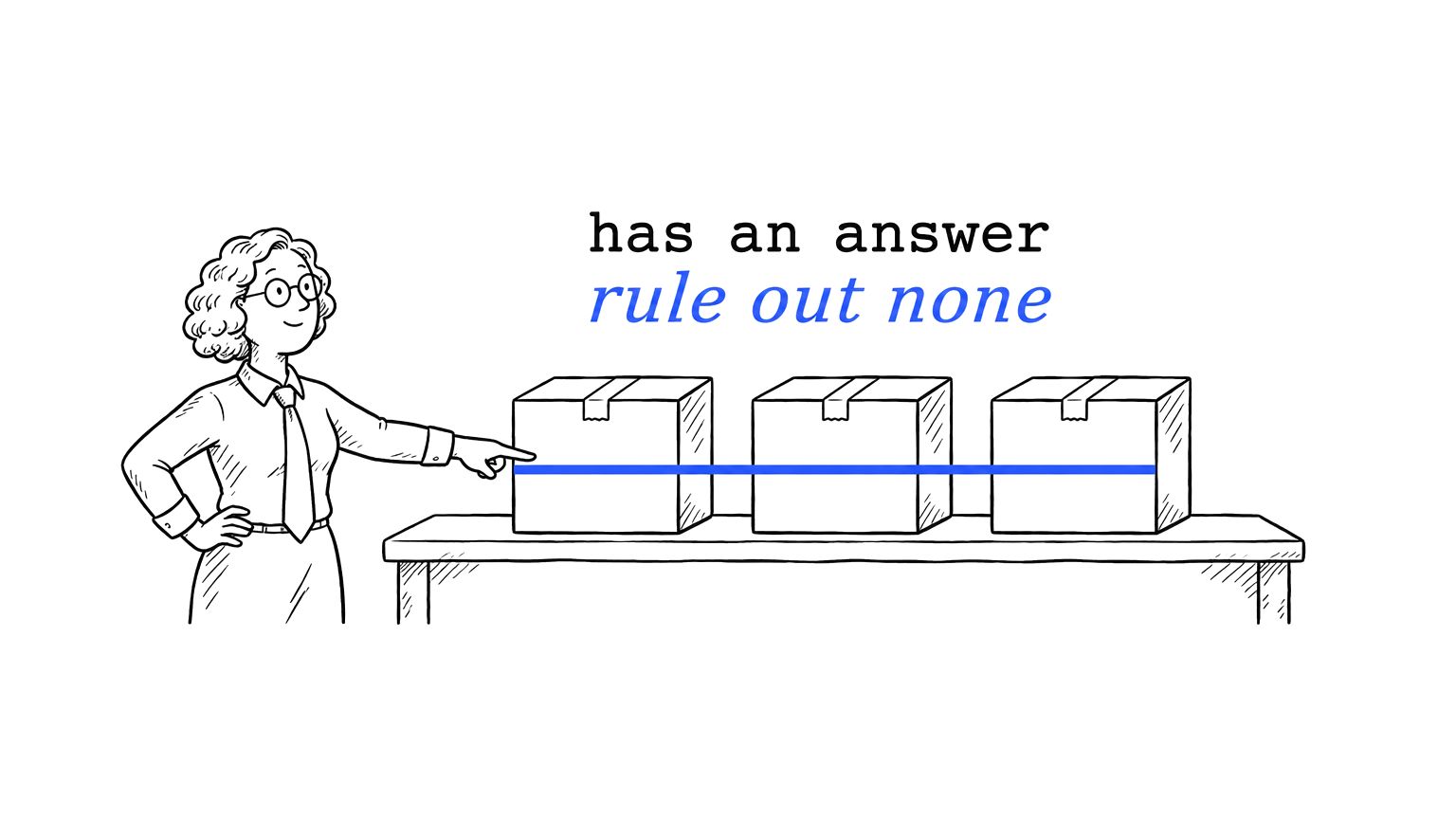
The review is at day 90. The slide has one line on it, and the line is flat.
Everyone in the room has an answer. Wait, because good work takes time. Or cut, because ninety days is a fair test.
Both sound like judgment. Neither comes from the line. A quarterly review is where slow work gets cut before it moves.
A flat line can mean three things. The effect is late. The dose was too small.
Or the test was too weak to see either. The dashboard that drew the line can rule out none of them. So you look for a case where a flat result got a fix.
Every one of them improved
Someone ran the experiment you wish you could run on a flat line. In 2017, David Montero and Carsten Lundby, at the University of Zurich, reported a six-week cycling study of 78 healthy young men. The men chose one of five groups, so nobody assigned them at random. The groups trained one, two, three, four or five one-hour sessions a week.
At six weeks, the researchers checked who had improved their fitness. In the one-session group, 69% had not. In the four- and five-session groups, nobody fell short. Then everyone who had not improved did six more weeks, with two extra sessions a week.
Every one of them improved.
Montero and Lundby concluded that non-response "is abolished by increasing the dose of exercise." Cyclists are not an audience. On that question of dose, Taylor, Kennedy and Sharp studied single-source panel data in four packaged-goods categories. They looked for a threshold in the immediate response to advertising: a minimum level of advertising needed to produce a response. They found none. They measured immediate response only. Read the cyclists as an analogy.
But the next year, Raffaele Mazzolari answered in the same journal. He wrote that the second round added more training and more time at once. So the design made it hard to isolate dose from time. Without a comparison group, he added, real differences between people were hard to separate from measurement error. The week-six check had told the researchers who had not improved.
It had not told them why.
Now look at your own review. The usual remedy is to extend the flight and raise the spend in one step. That is the same design. If the line rises, you will not know whether time or money did it. If it stays flat, you will not know which of three explanations to blame.
55 tests, one blind spot
Most marketers can't hold a matched control group out for a year. IRI's BehaviorScan household panel let researchers do it. A test group saw heavier TV advertising than a matched control group for one year, and the two groups were tracked afterward.
Leonard Lodish and five co-authors followed 55 of those tests for two more years after the extra advertising stopped. The only difference between the groups was that first year of weight.
In some tests, the heavier weight made a significant difference in year one. In those tests, the first-year sales impact roughly doubled, on average, over the following two years. Where it hadn't, on average nothing showed up later either. A full year inside a controlled test could separate "it works" from "it doesn't." It could not separate "late" from "too little," because the tests varied weight, not timing.
In 2020 the economists Shapiro, Hitsch and Tuchman wrote about Lodish's other 1995 study, a meta-analysis of 389 split-cable experiments. In those tests, IRI randomized advertising across households, as in the BehaviorScan markets. Lodish and colleagues had not reported the statistical power of the tests. Shapiro, Hitsch and Tuchman said it "was likely low." They put the ceiling at about 3,000 households in a test.
A 90-day dashboard is not that instrument either.
Set the date first
Go back to the review. Do it before the money moves. Pick the explanation your read is built to rule out.
If the worry is that the effect is late, decide how long the read runs before you accept a no. If the worry is too little, change one thing at a time: hold the dose, then raise it. If the worry is a test too weak to see anything, size the holdout so it can show a small effect.
A program that is already live can still do this. Hold the spend. Extend the window. Add a holdout. A holdout costs revenue, and how much is yours to price.
I don't think a quarter is the right clock for anything slow. A quarter can still be the right clock for a decision, as long as the read was built to answer the question.
Write down the date of your first acceptable no before the read starts.
~ Charles