
Order Beats Presence
Why the safest-looking way to use AI at work may be the one wearing down the judgment you're paid for.
I think the safest-looking AI setup in marketing is the one most likely to cost you your judgment.
You probably know the setup, because it's the one most teams reach for first. The model writes the draft. A person reads it, fixes what's off, and signs off. Nothing goes out without a human name on it.
It sounds responsible. There's a person in the loop, and the person has the final say.
Look at what the person actually does, though. They open a draft that already exists. The angle has been picked, the audience has been assumed, and the order of the argument is set. Their job is to read it and decide whether it's fine.
Most of the time it is fine. That's the trouble.
What protects your judgment isn't whether a person reviews the work. It's who made the first move.
Two ways across a city
Think about the last time you drove somewhere new with the phone giving directions.
You got there. Turn left in 300 feet, keep right, arrive. Could you draw the route afterward? Could you get back without the phone?
There are two ways to get across a city you don't know. You can build a picture of it in your head: where things are, how the streets connect, which way is north. Or you can follow the line the phone draws, one turn at a time.
Both get you to the door. Only one of them leaves you knowing where you are.
That sounds like a small difference. It turns out to show up in the brain.
The Knowledge
For more than 150 years, anyone who wants to drive a black cab in London has had to pass a test called the Knowledge. It usually takes three or four years. You learn the city's streets and landmarks well enough to recite the shortest route between any two points, from memory, to an examiner. No map, no phone. Until you pass, you don't take a single fare.
In 2000, Eleanor Maguire and her colleagues at University College London scanned the brains of London cab drivers. They looked at the hippocampus, the part of the brain that helps you hold a map of where you are.
The back of it was larger in the cab drivers than in people who didn't drive cabs. And the longer someone had been driving a cab, the larger it tended to be.
A scan like that can't prove the driving did it. People with a strong sense of direction may be the ones who make it through the Knowledge. But the drivers who had done the job longest had the most, which is what you'd expect if the work was growing it.
The follower's quiet brain
So what happens in the other seat, the one where the phone draws the line?
In 2017, a different team at the same university ran a different kind of study, with different people. Amir-Homayoun Javadi, Hugo Spiers and their colleagues had 24 volunteers learn the streets of Soho, in central London. Then the volunteers watched films of routes through it while their brains were scanned.
Sometimes the volunteers had to work out the way themselves. Then their hippocampus lit up each time they entered a new street. When they were told which way to go, that extra activity didn't show up. Being handed the next turn meant the brain skipped the work of picturing where each street might lead.
A third study looked at what that does over time. In 2020, Louisa Dahmani and Véronique Bohbot at McGill tested 50 regular drivers. People who had used GPS more over their lives had worse spatial memory when they had to find their way without it. Three years later they retested 13 of them. It's a small group. The ones who had leaned on GPS more in between showed a steeper decline.
None of these studies watched anyone use AI. The cab drivers and the volunteers are different people, studied in different ways, years apart. What they point to together is simpler. The part of you that builds the map stays strong when you use it. It goes slack when something else does the building.
The person following the phone watched every turn. They still didn't learn the city.
The review meeting, again
Now go back to the draft on your screen.
Reviews don't all work the same way. Sometimes you read a draft against something you already had in your head. You know who this is for, what they're half solving already, what you would never say to them. You catch things, because you're comparing two maps.
A lot of review doesn't work like that. The only map in the room is the one the draft brought with it. You check whether it reads well, whether the facts are right, whether the tone is on brand. You're checking the turns on a route someone else planned.
That's the follower's seat. The work gets done, the piece ships, and the part of you that decides where the piece should go never got asked.
I wrote about a version of this in the Perception Engine: teams that plan from inside the company answer the questions they care about, not the ones the customer arrives with. An AI draft can do the same thing, only faster. It hands you a sensible answer to a question nobody on the team actually framed.
What happens when you decide first
You'd think the fix is to review more carefully. Some researchers tested something closer to the real question.
In 2021, Zana Buçinca, Maja Barbara Malaya and Krzysztof Gajos at Harvard ran an experiment with 199 people. Each person looked at photos of meals and had to pick which ingredient to swap out to cut the carbs. An AI offered a suggestion, and sometimes the suggestion was wrong on purpose.
Some people saw the AI's answer right away, with an explanation. Others had to think first. In one version they made their own call before they were allowed to see the AI's. In another they waited 30 seconds for the answer to arrive, long enough to form a guess of their own.
The think-first versions cut how often people went along with the AI when it was wrong. They didn't fix it completely. People still followed bad suggestions sometimes.
The part that stuck with me came next. People trusted the easy versions more, and they liked them more. The setups where they did worse were the ones they preferred.
That's why "the model drafts, we review" feels safe. It's easier. It feels like control. The drafts read fine, and the numbers on the weekly report keep saying it's working: more pieces out, faster, at lower cost.
If you measure AI by how much more ships each week, this setup wins every time you check. The cost doesn't show up there. It shows up the day the phone dies. A brief lands that the model can't frame. A customer changes in a way nobody on the team has pictured. And the person who used to picture it hasn't had to in a year.
Isn't this just a metaphor?
It's fair to push back here, so I'll say plainly where the research stops and where I start.
The brain studies compare people who build their own map with people who follow directions. They don't test a person who plans first and then uses the tool. The Harvard study does change the order, but it measures single decisions about meals, not what happens to a marketer's skill over a year of reviewing AI drafts. It also helped some people more than others. The ones who enjoy hard thinking got the most out of it.
I haven't watched this break on a marketing team. I don't have a before-and-after from a client to show you, and I'm not going to invent one.
I do have a pattern that keeps showing up wherever people have looked. When something else does the building, the part of you that builds gets less practice, and you feel more comfortable, not less. When you have to make your own call first, even for a few seconds, you catch more of what's wrong.
That's an inference, not a proof. And moving first isn't free. It takes a few minutes every time, and across a week of drafts those minutes add up. Sometimes your frame will be worse than the one the model would have picked. I'd still pay it, and I'd rather tell you what it costs than pretend it's free.
Move first
The tool doesn't have to change. The order does.
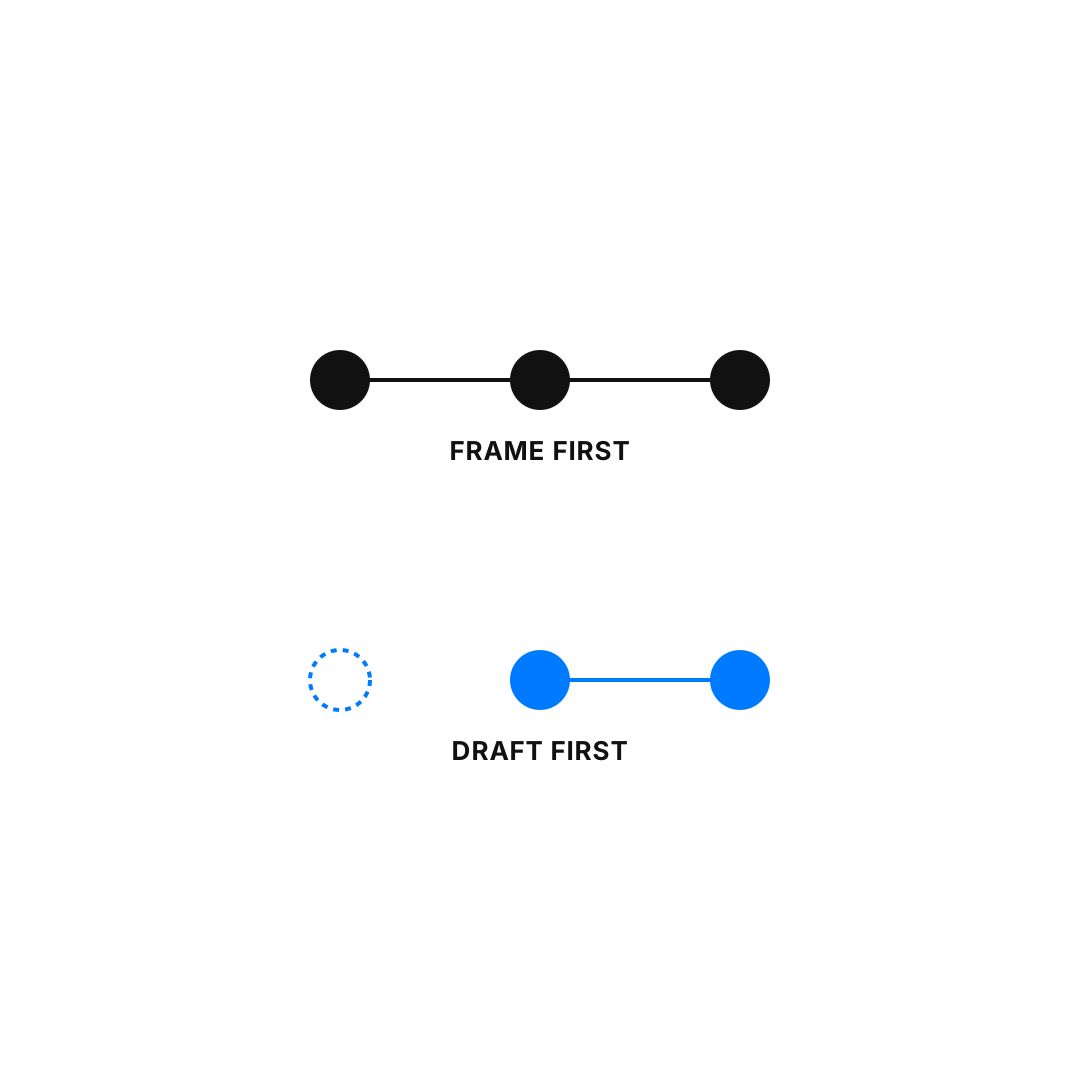
Before you open it, decide three things in your own words. Who is this for? What does it have to do for them? What would a good version look like? It can be a few rough sentences. What matters is that they're yours and they exist before the draft does.
Then let the tool do the work. It's fast, and it's good at a lot of things you don't need to do by hand.
Then read what comes back against what you wrote. Now you're comparing two maps. Where the draft wanders from yours, you have to decide which one is right. Sometimes it will be the draft, and you'll learn something. Either way, you had to think.
A cab driver who knows London can still use a phone. They just don't need it to know where they are.
~ Charles