
Proof of Transfer
You call a handoff done the moment you hit send, the same assumption that put two jets on one foggy runway in 1977.
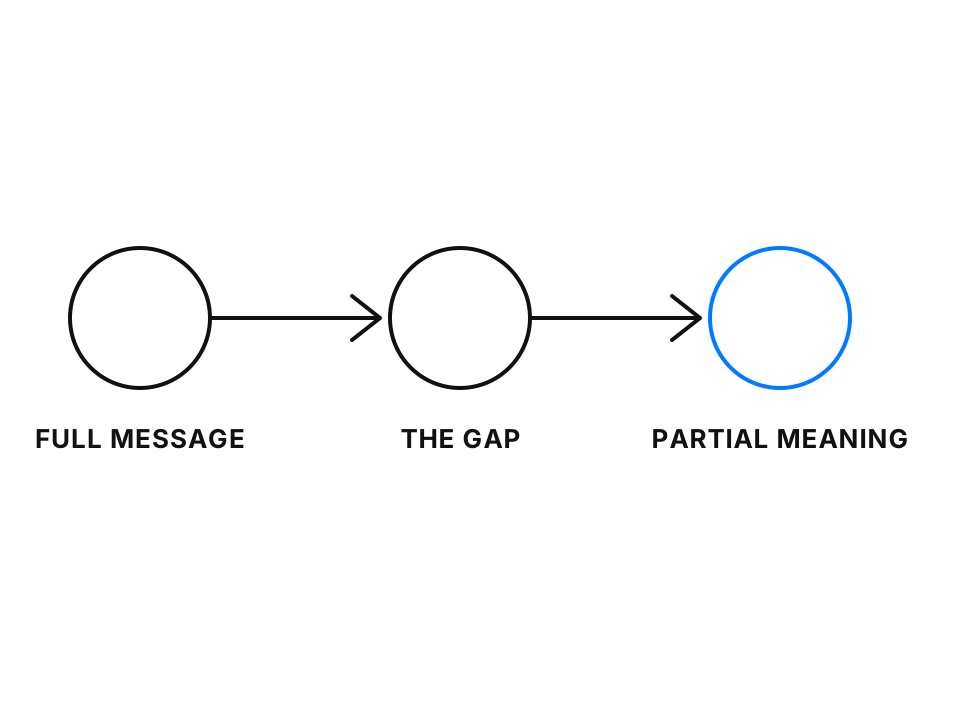
I think "I sent the recap" is one of the most expensive sentences in a handoff.
You know the moment. The kickoff call ends. Someone writes up the notes, tidies the action items, and sends them to everyone who was on the call and a few people who weren't. The brief goes to the agency. The deal notes go from sales to the team that has to deliver what was sold.
Then everyone moves on, because the handoff is done. There's a record now. If anything goes wrong later, you can point to it.
Look at what the recap actually proves, though. It proves you sent something. It doesn't prove anyone on the other end understood what you meant by it.
"I sent it" and "they have it" are two different facts. Most handoffs only ever check the first one.
I wrote in the manifesto that a plan loses something every time it travels through a brief or a handoff. This is where it goes missing.
The clearest case I know of where that gap was measured to the second happened on a runway in 1977.
One runway in the fog
On 27 March 1977, a bomb went off in the terminal at Gran Canaria's airport, in the Canary Islands. The airport closed. The planes headed there were sent to Los Rodeos, a small airport on the neighboring island of Tenerife.
Los Rodeos had one runway, with one taxiway running beside it. So many diverted jets parked on that taxiway that it stopped working as a taxiway. A plane that wanted to leave had to taxi down the runway itself, turn around at the far end, and take off from there.
Then the clouds came down. At Los Rodeos, low cloud drifts across the field in patches. Visibility can go from fine to almost nothing in a few moments. The controllers in the tower couldn't see the runway, and the airport had no ground radar. Everyone was working from what they could hear on the radio.
Two Boeing 747s were on that runway late in the afternoon. A KLM jet taxied to the far end and turned around to face the way it would take off. A Pan Am jet was told to follow it down the runway and turn off at the third exit.
The Pan Am crew wasn't sure they'd heard that right, so they asked. The controller answered: "The third one, sir; one, two, three; third, third one." They had the words. In the fog, with no signs on the exits, they couldn't find the turn the words described. They kept taxiing, looking for it.
"We are now at takeoff"
The KLM captain pushed the throttles forward as soon as the plane lined up. His co-pilot pointed out that they didn't have their clearance yet. The captain said, "No, I know that. Go ahead, ask."
The co-pilot radioed the tower, got the instructions for the route they'd fly after takeoff, and read them back. He finished with a sentence the Spanish investigation recorded as "we are now at take-off." Nobody knows for sure whether he said "at takeoff" or "taking off."
The tower heard every word. The controller took it to mean the plane was at the end of the runway, in position, waiting. He hadn't been asked for permission to take off. So he hadn't given it, and he didn't realize they were going.
They were. According to the Spanish report, the takeoff had started about six and a half seconds before the tower answered.
Nothing went missing in that exchange. Every word crossed the radio. What arrived in the tower was a different meaning from the one the cockpit sent.
Three seconds
The tower answered "OK." Then it added the part that mattered: "stand by for take-off ... I will call you."
At that same moment, the Pan Am crew, still on the runway somewhere in the fog, keyed their radio to say they were still taxiing down it.
Two people talking on one radio frequency don't take turns. Their signals run into each other. In the KLM cockpit, what came through was the "OK," and then a whistling sound that the Spanish report says lasted about three seconds.
The tower had sent a correction. Pan Am had sent a warning. Either one, heard in time, might have given the KLM crew a chance to stop. Neither one arrived.
The question that got through
A few seconds later, the tower asked Pan Am to report when it was clear of the runway. Pan Am said it would.
That exchange did come through in the KLM cockpit. The flight engineer heard it and asked, "Is he not clear, that Pan American?"
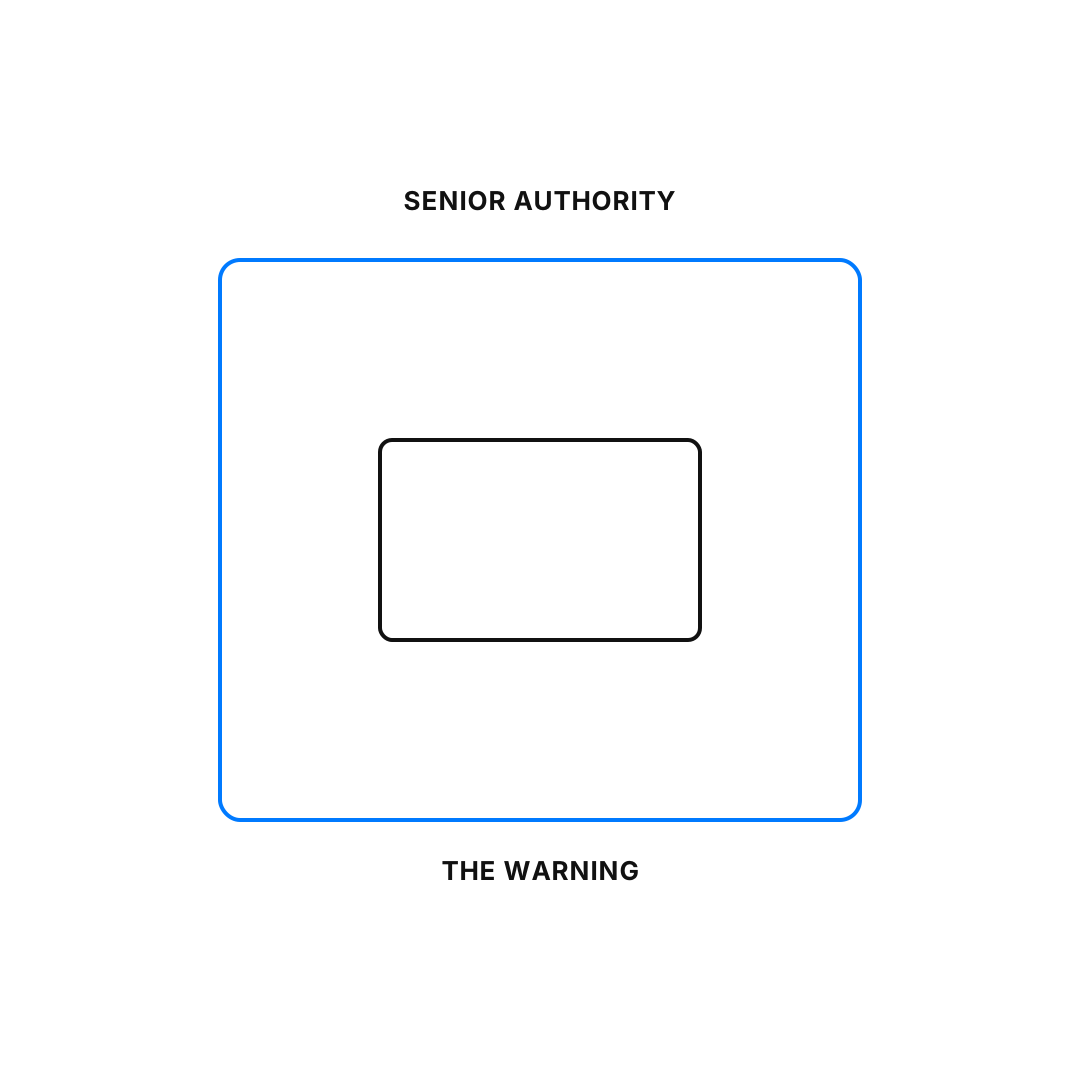
The captain was KLM's chief of flight training. He answered emphatically: "Oh, yes."
He kept going. Moments later the two planes collided in the fog. 583 people died, the deadliest accident in the history of aviation.
It's worth being careful about blame, because the investigators didn't agree. The Spanish investigation concluded that the captain took off without clearance. The Dutch authorities accepted that he'd taken off too early, but argued that it came out of a mutual misunderstanding and the limits of radio, and shouldn't rest on him alone. KLM later accepted responsibility.
I'm not going to settle that argument. What stands out to me is that three different things failed that afternoon, and the differences matter.
The first was meaning. "We are now at take-off" arrived word for word and was understood as something else.
The second was noise. Two people talking at once wiped out a correction and a warning.
The third was rank. The one question that got through, from the person asking exactly the right thing, was answered by the most senior pilot on board and dropped.
All three have one thing in common. At each point, someone sent something, and the sending got treated as if it had landed.
What aviation changed
You might expect the fix to be more communication. More calls, more confirmations, louder radios.
That isn't where the investigators pointed. Their safety recommendations were about the words. Use standard phrases in every routine radio call. And keep the word "takeoff" out of the instructions a plane gets before it's actually cleared to go.
That's a small change with a big idea under it. If a word can be heard two ways, a busy person will hear it the way they already expect to. So you take the loose word out, and you make careful wording part of how everyone talks, every time.
Aviation fixed the words. The other half is the check, and that's the part I've relied on again and again in my own work. A written account of what a handoff has to carry, and a check that it actually arrived, aren't two separate tools. They fail in different ways when you only have one of them.
With the document and no check, people believe they understand, and they stop asking questions. With the check and no document, there's nothing solid to check against, so both sides can agree while meaning different things.
That second failure is what happened with "we are now at take-off." The co-pilot's readback was the check. But there was no fixed meaning of "takeoff" for the tower to check it against, so the two sides agreed, and they meant different things. Reserving the word is how aviation gave that check something solid to hold on to.
Say it back
Now go back to your recap.
"OK, sounds good" is the tower's "OK." It tells you the message reached someone. It doesn't tell you what reached them.
The test I run comes from what I call the Story Anchor. It's the short story of why the client hired you, told so clearly that anyone on the team can repeat it without checking their notes. The anchor isn't finished when it's written. It's finished when it passes a test.
Give it to someone who wasn't in the room. Then ask them to tell you, in their own words, the one thing that would sink the work if they got it wrong.
If they can, the handoff is done. If they can't, it isn't, no matter how many people the recap went to.
The test isn't free. You need someone who wasn't in the room, and a few minutes of their time. And asking a colleague or a client to say your brief back can feel like you're doubting them. It gets easier when it's simply the last step of every handoff, the way careful wording is part of every radio call, so asking stops saying anything about the person.
Be clear about what this fixes. It closes the first gap, the one where every word arrives and the meaning doesn't. It won't stop two people talking over each other, and it won't make a senior person listen. It gives you one concrete thing to check before you tell yourself the handoff is over.
I also want to be honest about the distance between that runway and your inbox. Tenerife is this failure at its most extreme, in a place where one misread sentence could kill hundreds of people within a minute. It doesn't show how often the same thing happens in marketing, and an agency misreading your brief is not a plane crash. The people who died there are the cost of that story. They aren't proof of anything about yours.
What carries over is smaller and more useful. Hitting send feels like the end of a handoff. It's closer to the middle.
When a handoff goes wrong in your work, it goes wrong on your watch. Nobody will remember the recap sitting in your sent folder. They'll remember what the other side built from it.

The tower at Tenerife said the right words. Nobody on the other end ever said them back.
~ Charles