
The Position Lock
Why a plan everyone half-doubts keeps passing, and the two lines to write down before the next renewal.
You know the meeting. The plan comes up for renewal again, maybe for the third time, with a new brief and the same strategy underneath. A few people have said in the hallway that it isn't working.
In the room, someone suggests one more cycle with tighter targets. It passes.
It's easy to read that as cowardice, or as a leader who won't let go. I don't think either explains it.
The plan is optimized for everything except the customer, and everyone in the room is doing the sensible thing given what the room can see. I call this the Position Lock.
"They didn't see the CD-ROM coming"
Take Encyclopaedia Britannica losing to Microsoft's Encarta. The usual telling says the people inside were myopic. They didn't see the CD-ROM coming. It's a comfortable story, because it makes the lock a knowledge problem. Show people the data and it opens.
Did they see it coming? Shane Greenstein went back through the case for a paper in the Strategic Management Journal and reached the opposite conclusion. He was pushing back on the version in Blown to Bits.
Britannica's management, Greenstein wrote, did not "misperceive the opportunities and threats." In 1985 a Microsoft executive named Min Lee offered to pay a royalty to put the encyclopedia on a CD-ROM. Britannica quickly refused. Few homes had computers in 1985, and forecasts for them varied widely. A deal looked premature.
The commission a disc couldn't pay
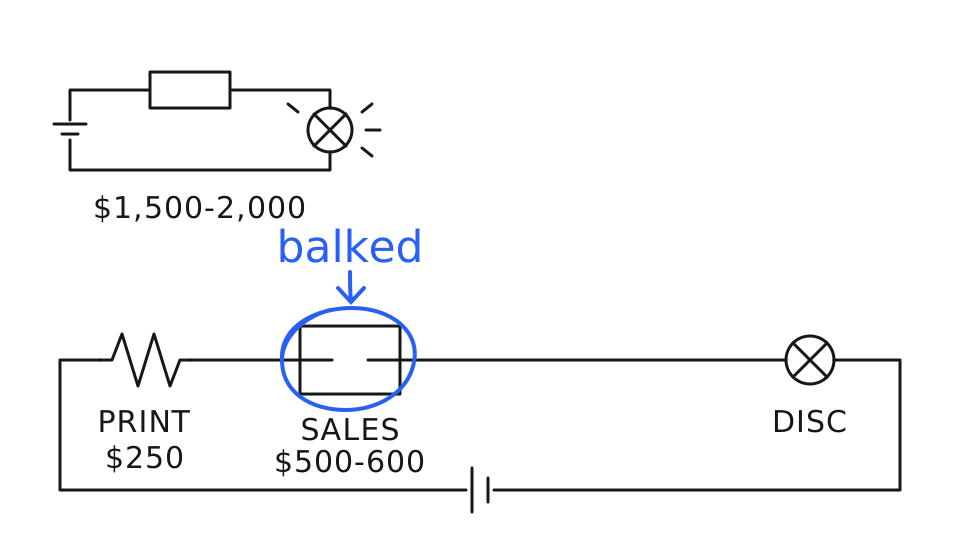
The trouble started when the disc became real. A Britannica set cost about $250 to print and sold for $1,500 to $2,000. The door-to-door salesperson earned $500 to $600 on every sale. A CD-ROM could not possibly generate a commission like that. The sales force balked.
So Britannica gave the disc away free with the print set. If you wanted the disc alone, it cost four figures. That plan found no traction. Within two years the disc alone cost $200.
By then print sales had fallen from 117,000 sets in 1990 to 51,000 in 1994. In 1996 the company's new owner disbanded the sales force.
Who owned each cost
Look at the two questions the company was answering.
What does leaving cost the people who sell this? That question had a number and a payee. At 1994's volume, 51,000 sets at $500 to $600 is about $26 to $31 million a year in commissions on the sets that still sold. That figure is my arithmetic, not Greenstein's. Every dollar of it belonged to someone who could walk into the next meeting and say so.
What does staying cost? That question had neither. It was a falling line on a revenue chart, from $650 million in 1990 to $453 million in 1994.
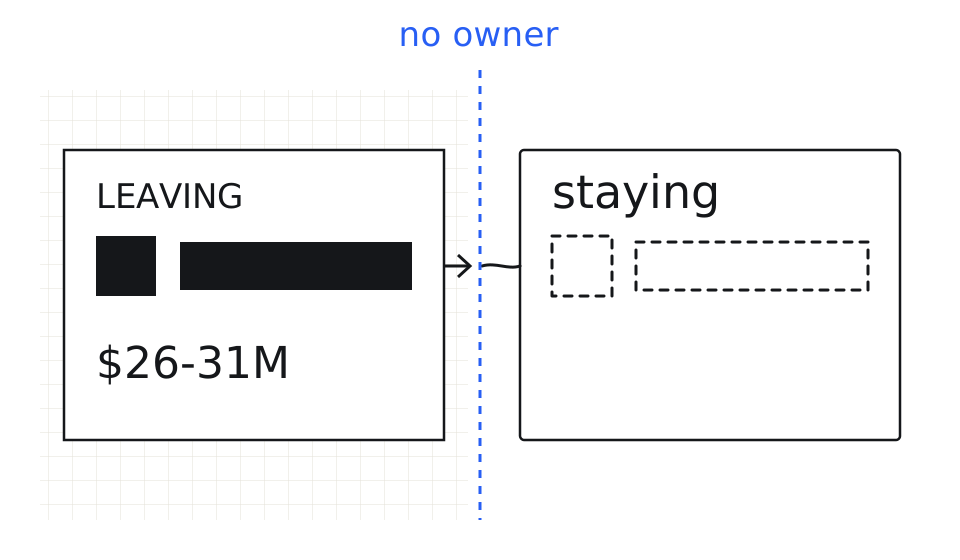
Greenstein notes that many doubted Encarta had anything to do with the decline, and that the sales force's pride in the Britannica name made it hesitant to see the urgency. My reading: nobody's name was on that loss, so nobody in the room had a number to bring against the commission.
Britannica is only the case where somebody wrote the arithmetic down. Your renewal probably has a version of that commission.
You could say Britannica simply had a bad sales-compensation plan. Greenstein writes that management "tried to work with that system instead of altering it." The reason isn't hard to see. The people whose pay you'd cut are the same people who sell your product door to door. "Consistency with the old won out over the needs of the new market." In retrospect, he writes, management faced no good option.
They had the evidence, and it moved nothing. A better argument wouldn't have moved it either. It was competing with a commission.
Write both exits down
Before your next renewal, put two lines on one page, in the same currency: what leaving costs and who pays it, and what staying costs and who pays it.
If the first line has a name and a number and the second has neither, you haven't found a reason to stay. You've found the lock.
Britannica priced the disc to protect the commissions. What would it have cost to pay them off? Then add a third line: what it would cost to pay the people who hold the exit, and by what date. A price you choose to pay is a different decision from a price you only try to avoid.
It may cost more than the company can pay. Then you'll know how big the lock is.
~ Charles